
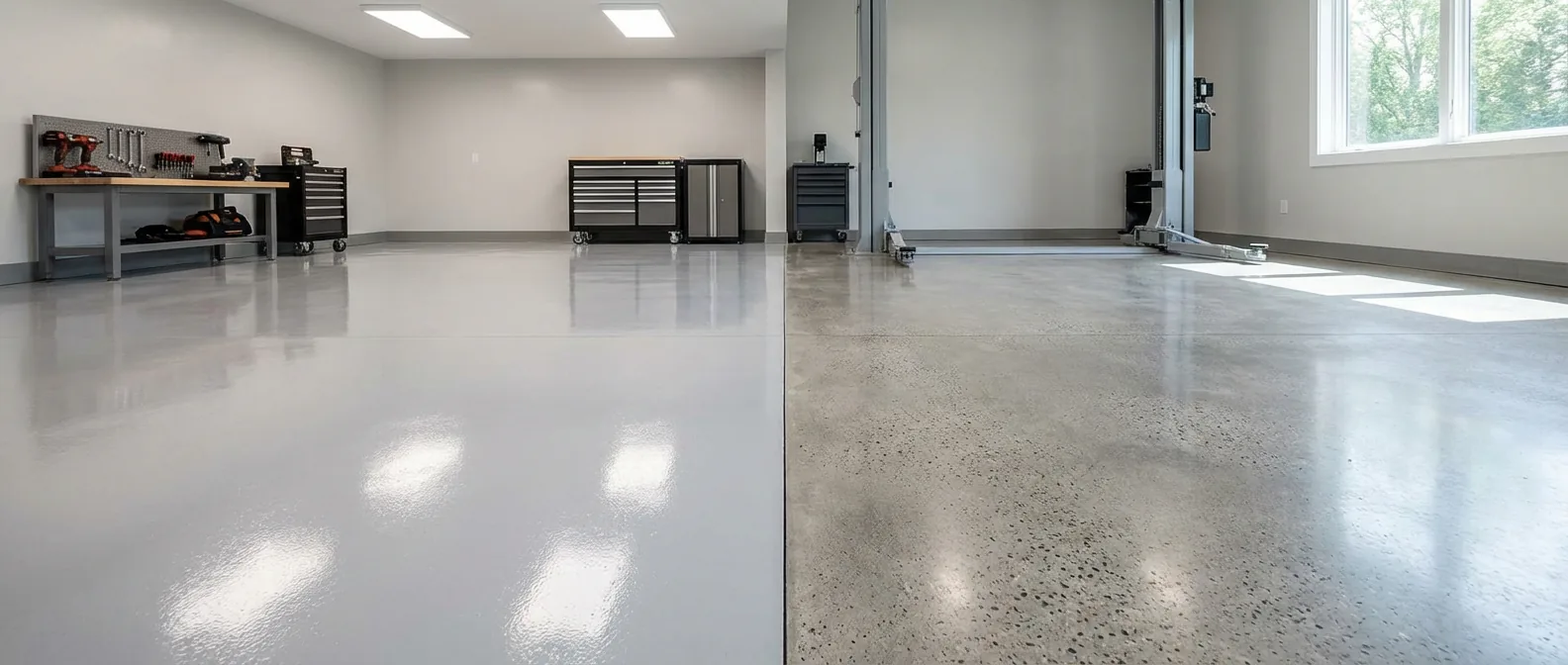
Garage epoxy vs polished concrete floors remain a hot topic for Melbourne’s Northern Suburb homeowners facing the challenge of selecting a durable garage floor finish. Between the toughness of epoxy garage floor coating and the sleekness of a polished concrete garage floor, deciding which lasts longest under everyday garage abuse can be daunting. This article cuts through the confusion with data-driven analysis focused on real-world longevity, maintenance demands, and cost-efficiency — essential knowledge for any property owner seeking a future-proof garage floor solution.
Introduction: Understanding Garage Epoxy vs Polished Concrete
What Defines Garage Epoxy Flooring?
Epoxy garage floor coating involves applying a resin-based polymer, typically a blend of epoxy resin and hardener, onto a prepared concrete substrate. The reaction creates a tough, seamless layer known for high chemical resistance, impact tolerance, and a glossy finish. Epoxy coatings for concrete floors are prized for their ability to protect against tire wear, oil stains, and moisture infiltration, making them a popular choice in utility areas like garages.
What Is a Polished Concrete Garage Floor?
A polished concrete garage floor is a mechanically enhanced finish produced through a multi-stage concrete polishing process, involving grinding concrete with progressively finer grit diamond tools to reveal a smooth, dense, and shiny surface. Unlike epoxy, polished concrete is integral to the slab itself and does not rely on topical coatings for wear protection, creating a natural, low-maintenance, and slip-resistant surface favored for durability and aesthetics alike.
Importance of Longevity and Durability in Garage Floors
Garages experience extreme conditions: vehicle traffic, heavy tools, fluctuating temperatures, and chemical spills. Choosing a floor with lasting durability directly impacts maintenance costs, safety, and the investment value of your property. Understanding the lifespan and wear mechanisms of epoxy versus polished concrete flooring will equip homeowners and contractors in Melbourne’s climate with practical knowledge to make informed, cost-effective flooring decisions tailored to their garage environment.
Next, we will explore the detailed materials and application processes that set epoxy and polished concrete apart in garage-specific use.
Materials and Application Processes: Epoxy Coatings vs Polished Concrete
Epoxy Garage Floor Coating Composition and Types
Epoxy cement floor coatings typically come as 100% solids, solvent-based, or water-based formulations. The most durable and preferred type for garages is 100% solids epoxy due to its excellent adhesion, chemical resistance, and thickness options. Specialty epoxy concrete paint blends may include additives for UV stability or slip resistance. Application involves mixing resin and hardener immediately before spreading with rollers or squeegees to form a uniform protective layer.
Concrete Polishing Process: Stages and Techniques
The concrete polishing process unfolds in several technical stages: initial grinding assesses and smooths rough surfaces, followed by several passes with progressively finer diamond abrasives (ranging from 30 to 3,000 grit) to refine the finish. Finally, densifiers impregnate the concrete to reinforce hardness, and sealers may be applied to boost stain resistance. This mechanical method transforms plain concrete into a lustrous, durable surface without added coatings. For related surfaces, coloured concrete driveway options also utilize advanced finishing techniques suitable for outdoor applications like driveways and garage floors.
DIY Epoxy Garage Floor Coating vs Professional Installation
While DIY epoxy garage floor coating kits are increasingly popular thanks to accessible formulation advances, professional installation offers superior prep, consistency, and longevity. Surface preparation—removing grease, etching, and repairing cracks—is critical for adhesion. Professionals employ industrial grinders and controlled environments ensuring curing at optimal temperatures, unlike typical DIY attempts, which risk peeling or uneven finishes.
Garage Concrete Floor Preparation for Both Methods
Preparation is foundational: for epoxy coatings, the concrete must be clean, dry, and roughened via shot blasting or acid etching to enhance bond strength. Polished concrete demands grinding to remove surface imperfections and expose aggregates for an even shine. Both methods require moisture vapor barriers beneath the slab in damp regions like Melbourne’s northern suburbs to avoid delamination or discoloration over time, a key determinant in garage floor coating lifespan.
With application protocols clear, the next section will investigate the critical lifespan and durability traits that determine which finish withstands everyday garage stresses best.
Longevity and Durability: Real-World Performance Comparison
Expected Lifespan of Epoxy Resin Garage Floors Under Garage Conditions
Typical epoxy resin garage floors last between 5 to 10 years under ordinary residential garage use (source: Flooring Contractors Association Australia, 2023). High-traffic or commercial-grade epoxy coatings with thicker layers and 100% solids formulas can extend durability beyond 15 years. However, factors such as temperature swings in Melbourne’s climate, direct UV exposure, and improper installation can shorten performance significantly. Epoxy’s susceptibility to chipping and yellowing under UV light without additives remains a longevity challenge.
Durability Metrics of Polished Concrete Garage Floors
Polished concrete floors show remarkable endurance, often exceeding 20 years with minimal wear under garage conditions. Their densified, abrasion-resistant surface does not peel or flake because the finish is integral to the concrete slab. CSA and ASTM tests rate polished concrete as highly resistant to compression and impact forces common in garages. Additionally, its natural hardness deters deep scarring from tire traction or dropped tools, making it ideal for long-term use in both residential and light industrial settings.
Resistance to Wear, Chemicals, and Impact for Both Floor Types
Epoxy coatings for concrete floors provide superior chemical resistance, effectively repelling automotive fluids like oil, gasoline, and brake fluids; however, concentrated spills may eventually stain or degrade lower-grade coatings. Polished concrete is more porous than epoxy but when sealed properly can resist chemical damage well. In terms of impact, epoxy’s flexibility allows slight deformation without cracking, whereas polished concrete is more prone to cracking if substrate movement occurs but fares better under localized heavy loads once cured.
Maintenance Frequency and Its Effect on Floor Longevity
Maintenance directly affects lifespan: epoxy floors typically require refinishing or recoating every 5-7 years, depending on wear severity, while polished concrete surfaces benefit from periodic resealing every 3-5 years, with routine sweeping and occasional wet mopping. Neglecting maintenance accelerates deterioration; frequent care extends both finishes’ useful lives substantially. This interplay underlines the importance of planning maintenance regimes aligned with expected garage use intensity.
Next, we explore the all-important cost and lifecycle analysis, enabling a clear financial comparison aligned with longevity insights.
Cost and Lifecycle Analysis: Which Flooring Is More Cost-Effective Over Time?
Initial Installation Costs: Epoxy vs Polished Concrete Garage Floors
Initial costs vary: installing a best epoxy garage floor coating with professional services typically ranges between AUD 60 to 90 per m² in Melbourne Northern Suburbs, influenced by epoxy type and substrate conditions (source: LMD Construction Estimates, 2024). Polished concrete garage floors command approximately AUD 50 to 100 per m², depending on polishing grit level and sealer choice. DIY epoxy garage floor coating kits present lower upfront costs (around AUD 25-40 per m²) but often involve trade-offs in quality and lifespan.
Ongoing Maintenance and Repair Expenses
Epoxy floors may incur regular recoat or localized repair costs every 5-7 years, with professional refinishing running AUD 15-30 per m². Polished concrete requires resealing at intervals costing roughly AUD 10-20 per m² but generally fewer repairs if initial slab preparation is optimal. Neglected epoxy floors could demand expensive stripping and full reapplications, whereas polished concrete’s densified nature reduces major overhaul frequency.
Lifecycle Cost Calculations Based on Typical Garage Use
| Floor Type | Initial Installation (AUD/m²) | Maintenance Cost Over 20 Years (AUD/m²) | Total Lifecycle Cost (AUD/m²) | Average Lifespan (Years) |
|---|---|---|---|---|
| Epoxy Garage Floor Coating | 75 | 90 | 165 | 10-15 |
| Polished Concrete Garage Floor | 75 | 40 | 115 | 20+ |
Factoring lifecycle costs, polished concrete presents a more cost-effective solution over a typical 20-year garage floor lifespan, as lower maintenance requirements and longer durability offset installation expenses.
Cost Factors Specific to Regions (e.g., Best Garage Floor Paint Australia Pricing)
In Melbourne Northern Suburbs, the best garage floor paint Australia pricing is influenced by local availability of 100% solids epoxies, labor rates, and climate adaptation requirements. Rising material costs and skilled labor shortages have elevated epoxy installations regionally, enhancing polished concrete’s competitive edge when balancing price and performance.
Having examined costs, we now compare the aesthetic and functional garage floor finishes side by side for homeowners prioritizing design and usability.
Aesthetic and Functional Garage Floor Finishes: Comparing Visuals and Practicalities
Appearance and Customization Options for Epoxy Garage Floors
Epoxy floors offer extensive customization possibilities including solid colours, metallic effects, fleck chips, and non-slip additives. Their high-gloss finish brightens garages by reflecting light and allows tailored branding or styling. Options such as floor epoxy flooring systems can mimic natural stone or integrate logo imagery for personalization. This versatility suits owners desiring a decorative statement alongside functionality. For cohesive home exterior looks, best coloured concrete finishes for driveways and garage floors extend these aesthetics beyond the garage into driveway and surrounding areas.
Visual Qualities and Finishes of Polished Concrete Garage Floors
Polished concrete garage floors provide a subtle, sophisticated sheen ranging from satin to high gloss depending on the grit level. The varied natural aggregate exposure adds texture and depth to the surface. While lacking epoxy’s colour range, polished concrete supports integral coloration or staining options for understated hues. Its non-reflective, matte finishes minimize glare, improving safety in naturally lit garages.
Impact of Garage Floor Coating on Lighting and Safety
Epoxy’s reflective surface improves illumination, reducing lighting needs in dim garages, but may contribute to slip hazards if overly smooth. Proper garage floor finishes include anti-slip additives to enhance traction. Polished concrete inherently offers moderate slip resistance especially when sealed with textured coatings, balancing safety and maintenance.
Usage Scenarios: Heavy-Duty vs Decorative Garage Floor Solutions
Epoxy floors excel in scenarios demanding chemical resistance and aesthetic impact — ideal for high-profile or workshop-style garages. Polished concrete’s hardwearing, low-maintenance surface suits heavy-duty use where durability and ease of cleaning outweigh decorative preferences.
Now, let us turn to maintenance strategies essential for maximizing your garage floor investment.
Maintenance and Care: How to Prolong the Life of Your Garage Floor
Cleaning and Upkeep of Epoxy Coatings for Concrete Floors
Routine cleaning involves sweeping to remove debris and damp mopping with pH-neutral cleaners. Avoid abrasive tools that might scratch epoxy painted floors. Prompt spill cleanup prevents staining or chemical damage. Annual inspections should check for chips or peeling areas requiring touch-ups.
Polished Concrete Maintenance Best Practices
Polished concrete demands periodic dust mopping and wet cleaning with non-acidic detergents to preserve sealers. Avoid waxes or harsh chemicals that degrade protective coatings. Re-sealing every 3-5 years helps maintain gloss and stain resistance (source: polished concrete floor costs, finishes, and maintenance best practices).
DIY vs Professional Maintenance Considerations
Many minor cleaning and resealing tasks can be DIY with proper products; however, deeper repairs or large-scale refinishing benefit from professional expertise, ensuring material compatibility and optimal longevity.
Common Issues: Peeling, Cracking, and Repair Tips
- Epoxy floors: Peeling often stems from poor surface prep or moisture issues; resurfacing or patching with compatible epoxy primers can correct flaws.
- Polished concrete: Cracks usually reflect substrate movement; small cracks can be filled and polished over, while major damage may require slab repair.
The following section evaluates environmental and health perspectives increasingly relevant to flooring choices.
Environmental and Health Considerations for Garage Floor Finishes
VOCs and Chemical Emissions in Epoxy Floor Coatings
Epoxy coatings vary widely in volatile organic compound (VOC) emissions. Water-based epoxies emit fewer VOCs but may compromise durability. 100% solids formulations comply with Australian Standards for low chemical release but require proper ventilation during application (source: Australian Department of Environment).
Environmental Impact of Polished Concrete Garage Floors
Polished concrete is considered eco-friendlier due to minimal added chemicals and the use of existing slab material. It reduces resource consumption compared to applying overlays or coatings and improves thermal mass properties, influencing garage temperature moderation. For those considering polished concrete, exploring its benefits in various home areas including kitchens and bathrooms can provide useful insights into maintenance and environmental impacts. polished concrete applications in homes and outdoors.
Safety and Slip Resistance for Garage Floor Coatings
Slip resistance is critical; both finishes can incorporate anti-slip additives or surface textures. Epoxy’s high gloss demands careful selection of non-slip aggregates. Polished concrete’s naturally textured finish generally offers safer traction without impairing cleanliness.
Eco-Friendly Alternatives and Innovations in Garage Floor Finishes
Emerging products include bio-based epoxy resins and low-impact densifiers for polished concrete, responding to growing demand for sustainable garage floor solutions without compromising durability or aesthetics.
Next, a concise summary table directly compares these key variables for quick reference.
Summary Comparison Table: Epoxy Garage Floor Coating vs Polished Concrete Garage Floor
| Feature | Epoxy Garage Floor Coating | Polished Concrete Garage Floor |
|---|---|---|
| Longevity | 5-15 years (depends on quality & maintenance) | 20+ years (with proper sealing & care) |
| Durability | High chemical & impact resistance, prone to UV yellowing | Dense, abrasion-resistant, less chemical resistant without sealers |
| Maintenance | Recoating every 5-7 years, regular cleaning | Sealing every 3-5 years, routine dust mopping |
| Installation Cost | Moderate to high (professional: AUD 60-90/m²) | Moderate to high (AUD 50-100/m² based on grit & seal) |
| Aesthetic Options | Highly customizable (colours, patterns, textures) | Natural stone-like appearance, limited colour staining |
| Slip Resistance | Depends on additives | Medium inherent slip resistance |
| Environmental Impact | VOC issues; advances in eco formulations ongoing | Lower VOC, uses existing slab with minimal additives |
Best use cases:
- Epoxy garage floors: Suitable for customised aesthetics, chemical-prone environments, and moderate lifespan expectations.
- Polished concrete garage floors: Ideal for heavy-duty, low-maintenance, long-lasting durability with subtle finish.
FAQs: Addressing Common Reader Questions for Garage Epoxy vs Polished Flooring Longevity
Can I apply epoxy resin garage floor coating myself, or is professional installation necessary?
DIY is feasible for small, well-prepared areas but risks include inadequate adhesion and uneven finishes. Professional installation ensures optimal surface preparation, product mixing, and curing conditions leading to longer-lasting results.
How often will I need to recoat or repolish my garage floor?
Epoxy floors generally require recoating every 5-7 years depending on use, while polished concrete needs resealing every 3-5 years. Regular maintenance extends these intervals.
Which floor finish better withstands oil stains and automotive chemicals?
Epoxy coatings offer superior chemical resistance, making them preferable where frequent automotive fluid exposure occurs, although sealed polished concrete can also perform well with prompt cleaning.
Does polished concrete garage flooring require sealing to improve durability?
Yes, sealers enhance stain resistance and gloss retention in polished concrete, extending lifespan and easing cleaning.
What is the best garage floor coating for cold or humid climates?
Epoxy formulations with moisture-tolerant properties or polished concrete with high-quality sealers are well suited; however, moisture barriers beneath the slab remain critical to prevent final floor failure.
For those exploring coordinated home flooring solutions, consider reviewing coloured concrete driveway options for complementary exterior finishes.
Choosing between garage epoxy and polished concrete ultimately rests on balancing durability, maintenance, cost, and aesthetic priorities tailored to your Melbourne Northern Suburb garage’s unique demands. Polished concrete offers unmatched lifespan and low upkeep, while epoxy flooring provides vibrant customization and strong chemical resistance. With this knowledge, your garage floor investment will endure and impress for years to come.
Ready to enhance your garage with a flooring solution that lasts? Contact your local experts or start planning your project today!
Frequently Asked Questions
What are the main differences between epoxy garage floor coating and polished concrete garage floors?
Epoxy garage floor coating creates a resin-based, glossy layer with strong chemical resistance, while polished concrete is a mechanically smoothed and densified slab offering natural durability and lower maintenance without added coatings.
How do maintenance requirements differ between epoxy coatings and polished concrete floors in garages?
Epoxy floors need recoating every 5-7 years and regular cleaning, whereas polished concrete requires resealing every 3-5 years with routine dust mopping, making polished concrete generally lower maintenance over time.
Why might polished concrete garage floors last longer than epoxy coatings?
Polished concrete is integral to the slab, avoiding peeling and UV damage, providing over 20 years of durability, while epoxy coatings can chip or yellow and typically last 5-15 years depending on quality and upkeep.
Can I use DIY epoxy garage floor coating kits for a durable garage finish?
DIY epoxy kits are suitable for small, well-prepared areas but may result in adhesion or finish issues. Professional installation offers better surface prep, mixing control, and curing for longer-lasting, high-quality finishes.
Which garage floor finish offers better slip resistance: epoxy or polished concrete?
Slip resistance depends on additives in epoxy coatings, while polished concrete naturally provides moderate slip resistance due to its textured surface, often making it safer without compromising cleanliness.
How do epoxy coatings and polished concrete floors compare in resisting oil stains and chemicals?
Epoxy coatings have superior chemical resistance, effectively repelling automotive fluids, whereas polished concrete, when properly sealed, resists stains but is generally less chemical resistant than epoxy.
Is polished concrete suitable for garages with heavy vehicle and tool traffic?
Yes, polished concrete is highly durable and abrasion resistant, making it ideal for heavy-duty garage environments where longevity and low maintenance are prioritized over decorative finishes.
When should I consider epoxy garage flooring over polished concrete?
Choose epoxy when you need extensive colour customization, high chemical resistance, or a glossy finish in moderate traffic garages, especially if aesthetics and branding are important.