
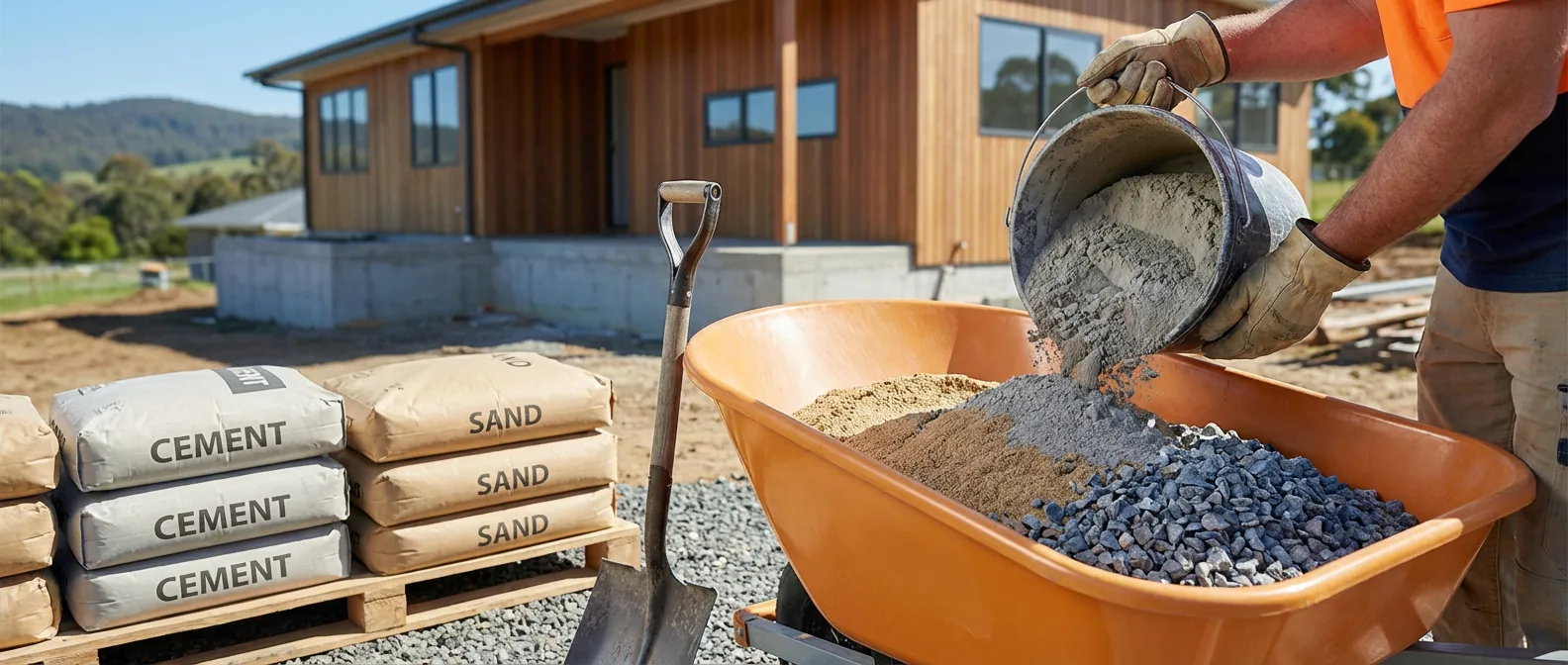
Mixing concrete that reliably achieves 25–32 MPa ratios is a critical skill for builders and DIYers working in Melbourne’s northern suburbs. Whether you’re laying foundations, driveways, or structural slabs, this precise range strikes a balance between strength and workability tailored for Australian conditions. This comprehensive guide reveals exact mix ratios, step-by-step instructions, and practical tips aligned with Australian Standards, ensuring your concrete hits the mark every time.
Understanding 25–32 MPa Concrete Mix Ratios in Australia
Understanding the difference between cement and concrete is fundamental before choosing the right mix ratios for achieving specified MPa strengths.
Defining 25 MPa vs 32 MPa Concrete Strength Classes
The term MPa stands for megapascal and measures the compressive strength of concrete, i.e., how much pressure it can withstand before failure. In Australian construction, 25 MPa and 32 MPa concrete are commonly specified for residential and commercial applications due to their balance of durability and cost-efficiency. For clarity on target strengths, see the section on MPa strength classes explained.
25 MPa concrete typically suits residential footings, driveways, and pathways where moderate load-bearing capacity is sufficient. 32 MPa concrete is often preferred for structural slabs, commercial floors, and areas where increased durability and strength are necessary.
Australian Standards Relevant to 25–32 MPa Concrete (AS 1379, AS 3600)
All concrete mixes in Australia must comply with standards such as AS 1379 (Specification and supply of concrete) and AS 3600 (Concrete structures). These specify material requirements, mix proportions, and curing regimes to ensure concrete achieves its design strength, including 25 and 32 MPa classes.
Importance of Accurate Mix Ratios for Strength and Durability
The key to achieving specified strength lies in accurate control over the mix ratios. The proportions of cement, sand, gravel, and water determine the concrete’s compressive strength, workability, and durability. Insufficient cement or excess water can compromise strength, while poor aggregate quality affects longevity.
Overview of Typical Materials Used in Australian Concrete Mixes
Australian concretes typically use: Portland or blended cements, locally sourced river sand or manufactured sand, clean gravels such as crushed granite or basalt, and potable water. Understanding the characteristics and performance of these materials in local mixes is essential for mix design.
For beginners, clarifying the types of cement used in Australian concrete mixes is a useful first step. Also, understanding the difference between cement and concrete underpins all successful mixing.
With this foundation, let’s explore precise ratios for our target strength range.
Exact Mix Ratios for 25 MPa and 32 MPa Concrete in Australian Context
Standard 25 MPa Concrete Mix Ratio Australia (Cement : Sand : Gravel : Water)
| Component | Typical Proportion (by volume) | Notes |
|---|---|---|
| Cement | 1 part | Usually Portland or blended cement per Australian standards |
| Sand (fine aggregate) | 2 parts | Clean, well-graded river or manufactured sand |
| Gravel (coarse aggregate) | 4 parts | Crushed granite or basalt preferred |
| Water | 0.45 to 0.5 (Water-Cement Ratio) | Aimed for sufficient workability without weakening |
This mix ratio roughly corresponds to a 25 MPa concrete mix ratio Australia standard, designed for moderate structural loads and good durability.
Standard 32 MPa Concrete Mix Ratio Australia
| Component | Typical Proportion (by volume) | Notes |
|---|---|---|
| Cement | 1 part | Higher cement content to improve strength |
| Sand (fine aggregate) | 1.5 parts | Well-graded for better packing density |
| Gravel (coarse aggregate) | 3 parts | Clean, durable aggregate essential |
| Water | 0.4 to 0.45 (Water-Cement Ratio) | Lower water to cement ratio for higher strength |
This 32 MPa concrete mix ratio entails a denser and stronger matrix, suited for higher-demand structural applications.
Water-Cement Ratio Recommendations for Target Strengths
The water-cement ratio critically controls strength: higher ratios increase workability but reduce strength and durability. For 25 MPa, ratios typically range 0.45–0.5, while for 32 MPa, 0.4–0.45 is optimal.
Monitoring water input using scales or volumetric buckets is crucial. Excess water is a common cause of weak mixes.
Variations in Mix Ratios for Different Applications and Weather Conditions
In hot or dry climates typical of northern Melbourne suburbs during summer, reducing water slightly or adding retarders can minimise rapid drying and cracking. Conversely, in cold or wet conditions, increased water or plasticizers help maintain workability.
Adjustments to aggregate grading can also influence strength and finish. Understanding local material properties and the intended use allows fine-tuning within the 25–32 MPa range.
Referencing the broader concrete mix ratios and strength guide will help contextualize these exact ratios within wider mix design principles.
Step-by-Step Process to Mix 25–32 MPa Concrete (Including Tools & Techniques)
Preparing Materials and Sourcing Local Australian Aggregates and Cement Types
Sourcing quality materials forms the base for consistent mixes. Choose cements certified for Australian standards — typically Portland or blended cements suitable for local conditions. River sand or manufactured sand conforming to grading standards and coarse aggregates like crushed granite are preferred for northern Melbourne.
Suppliers such as local quarries or builders’ merchants can provide certification or test data for aggregates, ensuring compliance and minimizing variability.
Measuring and Mixing Components Accurately (Batch Size and Proportioning)
- Decide batch size suitable for your mixer capacity and project needs.
- Measure cement, sand, and gravel by volume or weight — weighing is recommended for accuracy.
- Measure water precisely, adjusting slightly based on aggregate moisture content.
- Combine dry materials first, mixing thoroughly to achieve homogeneity.
- Add approximately 2/3 of the measured water while mixing, then add the remainder gradually to reach desired slump.
Accurate measurement is key; as noted by on-site Australian technicians, mis-measurement is a common cause of failure to achieve target 25–32 MPa strength.
Mixing Methods: Manual vs Mechanical Mixers (Best Practices)
For small batches or site repairs, manual mixing with a sturdy shovel or hoe in a wheelbarrow is possible but labor-intensive and less consistent. Mechanical mixers—portable drum mixers or concrete mixers—offer uniform blending, recommended for critical strength targets.
Mix duration should be at least 3-5 minutes for mechanical mixers to ensure full coating of aggregates and consistent hydration.
Understanding the best practices for mixing coloured concretes in Melbourne complements accurate 25–32 MPa concrete mixing techniques, ensuring consistent quality and finish.
Slump Test and Workability Adjustments for 25–32 MPa Mixes
The slump test measures workability and helps predict placement performance. For 25 MPa concrete, an ideal slump ranges 80–120 mm. For 32 MPa mixes, which tend to be drier for strength, 50–100 mm slump is common.
Adjust slump by slightly modifying water content or incorporating plasticizers (water reducers), especially in hot Australian conditions where workability diminishes quickly.
Learn more about concrete consistency through the concrete slump test procedures and ideal values.
Adding Admixtures (Plasticizers, Retarders) for Australian Conditions
In Melbourne’s varying climates, plasticizers improve flow without extra water, maintaining strength, while retarders delay setting to counteract rapid drying on hot days. Both additives must comply with Australian standards and be compatible with your cement.
Consult supplier datasheets and conduct trial batches to confirm the effect before large-scale mixing.
These admixtures are often essential for producing consistent 25–32 MPa concrete mixes adapted to local site challenges.
Curing and Quality Control for Concrete in the 25–32 MPa Range
Proper Curing Techniques to Achieve Design Strength
Curing ensures continuous hydration, helping concrete gain strength and durability. Methods include:
- Water curing – continuous wetting or ponding for 7 days minimum
- Plastic sheeting to retain moisture
- Curing compounds sprayed in hot/dry weather
Australian construction norms recommend curing periods of at least 7 days under normal conditions, extendable in colder weather.
Environmental and Climatic Factors Affecting Cure and Strength in Australia
Temperature extremes in Melbourne’s northern suburbs can accelerate or retard curing. High temperatures (>30°C) risk rapid moisture loss and cracking, while low temperatures (<10°C) slow hydration.
Proper planning and curing method selection tailored to site conditions mitigate these effects, as supported by CSIRO research on Australian concrete durability.
On-site Testing and Quality Assurance Procedures (Including MPa Strength Testing)
Concrete quality control involves slump testing, sampling, and compressive strength testing at 7, 14, and 28 days. Testing protocols conform with AS 1012.9.1 and ensure the mix meets the specified 25 or 32 MPa strength class.
Common Issues and Troubleshooting Poor Strength or Workability
Common causes of failing to reach 25–32 MPa targets include:
- Excess water diluting strength
- Poor aggregate quality or grading
- Incorrect cement dosage
- Improper mixing duration
- Inadequate curing
Addressing these through systematic measurement, testing, and consistent procedures guarantees better outcomes.
Practical Tips and Adjustments for Optimising 25–32 MPa Concrete Mixes in Australia
Adjusting Mixes for Different Australian Regions and Climates
The northern Melbourne suburbs experience seasonal heat peaks and occasional cold snaps. Mixes should include plasticizers for summer and extended curing times in winter. For arid inland zones, consider water retention additives or internal curing techniques.
Using Recycled or Alternative Aggregates within the 25–32 MPa Range
Incorporation of recycled aggregates must be done cautiously. Studies by the Australian Road Research Board (ARRB) show that limited replacement (<20%) can maintain strength if particle cleanliness and grading are managed.
Choosing between fibre vs steel reinforcement for concrete can affect mix performance in specific applications and is an important consideration when optimising 25–32 MPa concrete mixes.
Cost-Effective Sourcing of Materials Without Compromising Strength
Local sourcing reduces transport costs and environmental footprint. Builders in Melbourne’s north benefit from established suppliers of standard cement types and aggregates ensuring compliance and uniformity without premium pricing.
Recommended Tools and Equipment for Small and Large Scale Mixing
Use volumetric or weighing scales and mechanical mixers for batch accuracy. Trowels, shovels, wheelbarrows, and slump cones are practical essentials. For large-scale projects, consider on-site batch mixers with integrated water dosing systems.
Homeowners may find referencing coloured concrete driveway options in Melbourne helpful for inspiration on combining strength with aesthetics in concrete applications.
FAQs and Expert Insights on 25–32 MPa Concrete Mix Ratios in Australia
Frequently Asked Questions Covering Common Reader Doubts
- Q: Can I use any sand to make 25–32 MPa concrete?
- A: No. Use clean, well-graded sand meeting Australian aggregate standards to ensure proper strength and workability.
- Q: How much water can I add without weakening the mix?
- A: The water-cement ratio should remain between 0.4–0.5 depending on target strength. Excess water reduces strength significantly.
- Q: Are plasticizers necessary in Australian conditions?
- A: They are highly recommended in hot, dry weather to improve slump without extra water, particularly for 32 MPa mixes.
- Q: How long must I cure concrete for 25–32 MPa strengths?
- A: Minimum 7 days curing (moisture retention) is standard—longer in cold or arid conditions.
- Q: Can recycled aggregates be safely used?
- A: Limited recycled aggregate replacement (<20%) is possible if quality is verified and mix proportions adjusted accordingly.
Expert Tips from Australian Concrete Technicians and Builders
“Monitoring water strictly and using quality local aggregates from certified suppliers has been the single biggest factor in consistently achieving 25 to 32 MPa concrete strength in Melbourne projects.” — Sarah Mitchell, Lead Concrete Technician, VIC
“Adjust your curing regime to the season. In summer, wet curing or plastic sheeting helps prevent surface cracking — a common issue that compromises strength even if the mix was perfect.” — John Davies, Construction Foreman, Northern Melbourne
Summary of Best Practices for Consistent 25–32 MPa Concrete Batches
| Best Practice | Rationale |
|---|---|
| Use cement and aggregates complying with AS 1379 and AS 3600 | Ensures base materials support required strength |
| Maintain water-cement ratio within recommended range | Balances workability and strength |
| Accurate measuring and thorough mixing | Prevents weak spots and inconsistencies |
| Perform slump testing to confirm workability | Ensures mix suits placement methods |
| Apply curing appropriate to local climate | Prevents premature drying and strength loss |
| Consider admixtures for improved performance | Enhances workability and weather resistance |
Combining these methods guarantees concrete strength in the 25–32 MPa range, suitable for quality Northern Melbourne construction.
With these precise mix ratios, tailored mixing procedures, and local optimisation tips, you are now equipped to achieve consistent and durable concrete blends that meet Australian standards. Ready to get started? Mix smart, cure carefully, and build with confidence.
Frequently Asked Questions
What is the difference between 25 MPa and 32 MPa concrete mixes?
25 MPa concrete has a lower cement content and coarser aggregate ratios, suitable for moderate load applications. 32 MPa concrete contains more cement with finer aggregate grading and a lower water-cement ratio, resulting in higher strength and durability for structural demands.
How do Australian climate conditions affect 25–32 MPa concrete mixing?
Hot and dry conditions require reduced water or retarders to prevent rapid drying and cracking, while cold or wet climates benefit from increased water or plasticizers to maintain workability and ensure proper curing for strength.
Why is the water-cement ratio critical in 25–32 MPa concrete mixes?
The water-cement ratio directly influences concrete strength and durability; too much water reduces compressive strength, while too little affects workability. Maintaining the recommended 0.4–0.5 ratio ensures optimal balance.
When should plasticizers be used in 25–32 MPa concrete mixes?
Plasticizers are ideal in hot, dry conditions or when workability needs improving without adding water, especially for 32 MPa mixes where strength must not be compromised by excess moisture.
Which aggregates are best for achieving consistent 25–32 MPa concrete strength?
Clean, well-graded river or manufactured sand and durable gravels like crushed granite or basalt are preferred for their reliability and compliance with Australian standards, ensuring consistent strength and durability.
Can recycled aggregates be used without affecting 25–32 MPa concrete performance?
Yes, limited replacement (under 20%) is acceptable if recycled aggregates are clean, properly graded, and the mix is adjusted. Quality checks are essential to maintain strength and durability.
How does slump testing help in mixing 25–32 MPa concrete?
Slump testing measures workability and consistency, guiding water or admixture adjustments to ensure the concrete mix can be properly placed and finished without compromising strength.
Is mechanical mixing always required for 25–32 MPa concrete?
Mechanical mixing is recommended for uniformity and achieving target strength, especially for larger batches, but manual mixing is possible for small repairs if done thoroughly and accurately.