
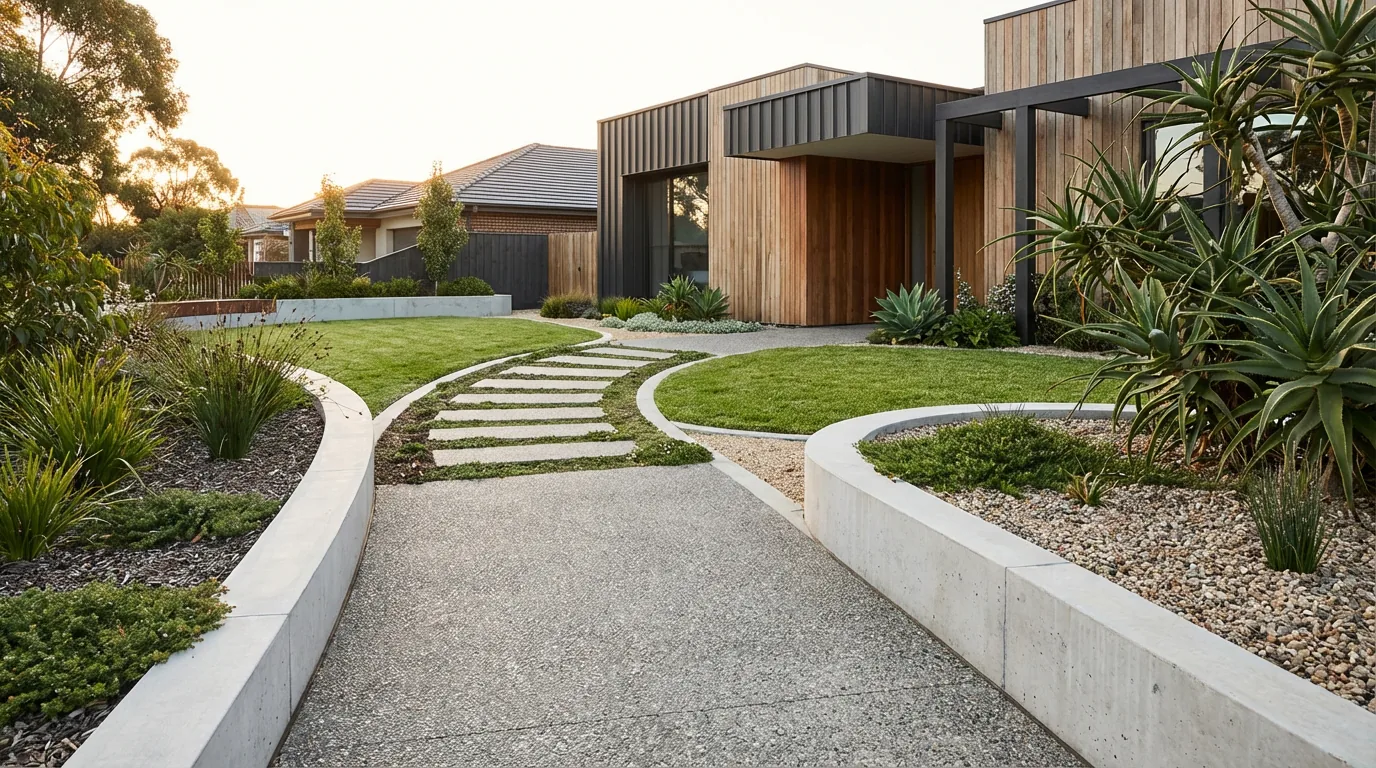
Concrete landscaping is a robust way to enhance both the function and aesthetic appeal of your outdoor spaces. In Melbourne’s Northern Suburb, where climate and architectural styles demand durable yet stylish solutions, understanding how to effectively integrate landscaping pillars, concrete paths, edging, and kerbs can transform any garden or driveway into a lasting statement. This comprehensive guide explores practical ideas, technical installation tips, and maintenance advice tailored specifically to Melbourne’s environment and regulatory landscape.
Understanding Landscaping Pillars and Their Role in Concrete Landscaping
What Is a Landscaping Pillar? Structural and Aesthetic Functions
A landscaping pillar serves as a fundamental structural feature, providing support and foundation for various design elements such as gates, fences, or garden features. Beyond their utilitarian role, these pillars are pivotal as aesthetic focal points that anchor outdoor spaces, creating visual hierarchy and balance.
Structurally, landscaping pillars enhance the stability of concrete features by distributing loads and resisting lateral forces common in outdoor environments. Architecturally, they can be designed in myriad shapes, including square, round, or decorative moulded forms, integrating materials like precast concrete or rendered block work to complement Melbourne’s predominant architectural styles.
Choosing the right outdoor concrete landscaping pillars is essential for structural integrity and style, as detailed in our guide to the best concrete pillars for outdoor landscaping.
Integrating Landscaping Pillars with Concrete Paths and Edging
When combined with concrete edges and concrete pathways, landscaping pillars create a cohesive boundary and directional flow throughout the garden or driveway. For example, pillars can serve as transition markers along a concrete walkway or as bookends to a garden path around the house, reinforcing spatial definition.
Designers often incorporate low-level concrete balustrades or lighting fixtures atop landscaping pillars, enhancing their visual prominence and usability during evening hours. In Melbourne’s residential settings, the coordinated use of these pillars alongside stamped or coloured concrete paths adds an elegant, coordinated finish.
Melbourne’s Climate Impact on Landscaping Pillars and Concrete Elements
Melbourne’s temperate oceanic climate, characterised by seasonal rainfall and occasional heatwaves, influences the structural integrity and durability of concrete landscaping pillars. Concrete mixes with specific additives for water resistance and thermal stability are recommended to mitigate cracking caused by freeze-thaw cycles and heat expansion.
According to research by CSIRO, outdoor concrete structures in Melbourne benefit from curing practices tailored to fluctuating humidity and temperature, reducing early-age shrinkage and enhancing lifespan. Proper sealing of landscaping pillars and adjacent paths also prevents moisture ingress, which is crucial given Melbourne’s variability in rainfall distribution throughout the year.
With this foundational understanding of landscaping pillars, we now turn to the first critical landscape component: concrete paths and walkways.
Designing and Installing Concrete Paths & Walkways
Types of Concrete Paths: From Driveways to Backyard Concrete Walkways
Concrete paths vary widely in style and function, ranging from formal driveways to naturalistic backyard walkways. Common types include broom-finished concrete driveways, exposed aggregate pathways, decorative stamped concrete, and plain cement paths around the house for practicality.
In Melbourne’s Northern Suburb, homeowners often select backyard concrete walkways that balance aesthetics with durability against soil types that can vary from clay-heavy to sandy. Overlaying concrete pathways with colouring agents or acid stains allows integration with native landscaping and Victorian-era home facades common in the region.
Design Inspirations for Concrete Pathways Around the House
Practicality meets style with designs inspired by geometric patterns, curved organic lines, and multi-textured finishes. Choosing pathways that flank the house or connect garden zones benefits from edged borders that prevent soil creep and clearly define pedestrian areas.
Innovative options include multi-level stepping slabs offset for visual interest or combining precast concrete pavers with traditional cast concrete infills. These design choices inject personality while sustaining ease of maintenance and accessibility.
Installation Techniques for Durable Cement Paths in Melbourne
- Site Preparation: Remove vegetation and achieve proper grading to direct water drainage away from the house.
- Sub-base Installation: Compact a layer of gravel or crushed rock approximately 100mm thick to provide foundational support.
- Formwork Setup: Use timber or metal forms to shape the path edges accurately, ensuring alignment with adjacent landscaping pillars or edging.
- Reinforcement: Place steel mesh or reinforcing bars to improve tensile strength and control cracking, essential for Melbourne’s variable soil conditions.
- Concrete Pouring: Use a concrete mix suited for outdoor application with additives for workability and durability. Pour and screed smooth, then apply the chosen surface finish (broom, exposed aggregate, stamped).
- Curing: Protect the concrete from premature drying with wet coverings or curing compounds—preferably during Melbourne’s warmer and windier months—to optimise strength and longevity.
For durable coloured concrete driveways that complement your pathways, refer to our detailed guide on best coloured concrete driveway options in Melbourne.
Installation techniques proven effective for Melbourne conditions are demonstrated in our dedicated article on concrete pathway installation techniques in Melbourne.
Maintenance Tips and Concrete Patching for Pathways
Common wear involves hairline cracking and surface spalling due to temperature swings and foot traffic. Regular cleaning with gentle detergents prevents stain buildup, while prompt application of concrete patching compounds addresses minor defects before they propagate.
For deeper maintenance, using polymer-modified repair mortars compatible with the original concrete mix is critical. These techniques extend the lifespan of concrete walkways tailored for residential landscaping Melbourne environments.
Next, we explore the vital role of concrete edging in defining and protecting these paths and spaces.
Concrete Edging and Driveway Edging Solutions
Functional Benefits of Concrete Edges and Driveway Edging
Concrete edges provide clean, durable borders to garden beds, paths, and driveways, preventing soil erosion and weed invasion. In concrete driveway edging, these edges protect asphalt or aggregate surfaces from lateral stresses caused by vehicle turning forces, preserving structural integrity.
Additionally, edging simplifies mowing and garden maintenance by creating firm boundaries that resist root encroachment.
Stylish Concrete Edge Designs for Residential Landscaping Melbourne
Concrete edging designs range from simple straight lines to ornate curvilinear forms. Melbourne homeowners often favour exposed aggregate edging with natural stone textures that complement local gardens.
Raised edging profiles can double as informal seating or planter walls, underpinning the landscaping pillar concept by integrating structural and aesthetic roles within the outdoor space.
Step-by-Step Guide to Installing Concrete Driveway Edging
- Marking and Excavation: Use string lines to mark edge boundaries and excavate 150-200mm deep trenches aligned with driveway contours.
- Base Preparation: Lay and compact a sub-base of crushed rock to prevent settling and movement.
- Form Setting: Insert form boards or metal forms to shape the edge profiles precisely.
- Concrete Placement: Pour concrete with suitable slump for edging, consolidate, and finish edges with trowels to achieve smooth or textured surfaces.
- Curing and Sealing: Apply curing compounds and consider sealer finishes that protect against Melbourne’s climatic exposure and staining.
To broaden your design options, consider exploring coloured concrete driveway options in Melbourne which can enhance your concrete driveway edging with vibrancy and style.
For additional inspiration on creative concrete edging styles and ideas, refer to our resource focused solely on residential landscaping edging innovations.
Maintaining Concrete Edges: Repair and Longevity Practices
Regular inspection for cracks and displacements ensures early intervention. Concrete patching is frequently needed around joints due to freeze-thaw cycles and mechanical impact.
Applying penetrating sealers annually shields edges from moisture ingress and reduces algae growth, common in Melbourne’s wetter months.
Having addressed edging, the next section delves into the essential component of kerbs in residential concrete landscaping.
Exploring Concrete Kerbs: Types and Installation
Understanding What Is Kerbing: Definitions of Road Curb and Road Kerb
Kerbing refers to the continuous raised barrier along roads or pathways designed to direct water flow and secure pavement edges. The terms road curb and road kerb are often used interchangeably in Australia, though “kerb” is more regionally specific.
In landscaping, concrete kerbs act as boundaries holding soil or mulch, defining space, and supporting adjoining hardscapes such as driveways and footpaths.
Precast Concrete Kerbs vs. On-site Cast Kerbs: Pros and Cons
| Kerb Type | Advantages | Disadvantages |
|---|---|---|
| Precast Concrete Kerbs |
|
|
| On-site Cast Kerbs |
|
|
Practical Applications of Concrete Kerbs in Melbourne Landscaping
Concrete kerbs in residential landscaping serve to delineate driveways, garden edges, and pedestrian zones while managing storm water runoff. Popular choices include precast concrete kerbs for their durability and uniformity, especially where regulatory compliance with regional drainage standards is required.
Melbourne’s residential council guidelines often specify kerbing profiles suitable for suburban streets and private driveways, influencing landscaping design choices.
Installation Standards and Local Regulations in Melbourne
Installation of concrete kerbs in Melbourne must comply with local authority requirements such as those set by VicRoads and relevant municipal councils, mandating specific kerb heights, drainage slopes, and setback distances.
Preparation includes compacted subgrades, alignment verification, and concrete mix specifications adhering to Australian standards such as AS 3600 Concrete Structures. Precise installation prevents premature cracking and erosion under Melbourne’s fluctuating weather.
For an in-depth discussion on how to select the most appropriate concrete kerbs tailored to Melbourne’s unique regulations and conditions, see our dedicated guide to selecting concrete kerbs suitable for Melbourne.
With paths, edging, and kerbs covered, integrating these elements creates unforgettable outdoor environments.
Combining Concrete Elements for Cohesive Landscaping Designs
Innovative Patio Concrete Designs and Layout Ideas
Patio concrete designs often blend texture, colour, and structural elements like landscaping pillars to create inviting social spaces. Melbourne’s modern homes favour coloured or stamped concrete patios mimicking natural stone or timber.
Using exposed aggregate finishes with complementary concrete edges enriches tactile experience and visual contrast. Multi-tone pours that highlight kerbs or pillars add depth and sophistication to outdoor living areas.
Landscaping Pillar Integration with Paths, Edges, and Kerbs
Landscaping pillars, when thoughtfully positioned, can serve as gateways between zones — for example, near concrete walkways that lead from patios to gardens or driveways. Edging lines extend from these pillars, visually guiding the flow and enhancing spatial harmony.
The combination strengthens property boundaries and enhances security while offering aesthetic consistency across all concrete landscaping features.
Examples of successful integration are showcased in our case studies featured in the article on residential landscaping Melbourne examples.
Case Studies: Residential Landscaping Melbourne Showcasing Concrete Features
Case Study 1: A Northern Suburb home replaced aged timber fences with rendered concrete landscaping pillars, incorporating precast concrete kerbs and broom-finished paths around the house. The durable yet elegant approach suited the climate and increased the residence’s market appeal.
Case Study 2: A landscaped backyard featured a series of raised concrete pillars framing a stamped concrete patio with garden edging that doubled as seating walls. This multifunctional use reflected best practices in integrating all landscaping elements for beauty and utility.
Balancing Aesthetics and Functionality in Backyard Concrete Projects
Homeowners must strike a balance between visual appeal and practical concerns like drainage, maintenance, and slip resistance. Selecting finishes that benefit from concrete patching ease and long-term durability ensures backyard concrete remains attractive and safe through Melbourne’s seasonal changes.
With these design inspirations, it’s essential to consider regional standards that govern material choices and installation quality.
Regional Considerations: Materials, Standards, and Climate Factors in Melbourne
Concrete Material Availability and Suitability for Melbourne Projects
Melbourne’s strong industrial concrete supply chain enables access to a range of tailored mixes, including high-performance blends and environmental variants with reduced carbon footprints. Local quarries produce aggregates that conform to Australian standards, ensuring consistent quality.
Contractors recommend specifying concrete grades between 25 to 40 MPa for residential landscaping to withstand foot and vehicle traffics common in Melbourne’s suburbs.
Melbourne’s Climate and Its Effect on Concrete Longevity and Performance
Melbourne’s climate requires concrete mixes with admixtures that improve resistance to shrinkage cracking and moisture penetration. During hot summers, rapid hydration can cause surface defects, while winter rains may affect curing stages if precautions are not taken.
The Bureau of Meteorology reports increased variability in rainfall and temperature extremes in the region, making adherence to proper placement and curing methodologies critical for landscaping pillars, paths, and kerbs.
Regulatory and Industry Standards for Residential and Industrial Concreting Melbourne
Australian standards such as AS 3610 Formwork and AS 4586 Slip Resistance mandate safety and quality parameters. Residential landscaping Melbourne typically demands lighter concrete specifications compared to industrial concreting Melbourne, which involves heavier load considerations.
Understanding the differences allows homeowners to select appropriate contractors and materials tailored to their project scale.
Comparing Industrial Concreting Melbourne and Residential Landscaping Practices
While industrial concreting Melbourne focuses on large-scale durability and fast turnaround, residential projects emphasize aesthetics, integration with existing structures, and compliance with neighborhood standards. For example, finish options and kerb profiles differ substantially between sectors.
This distinction helps homeowners plan realistic budgets and timelines aligned with their space’s intended use and local council requirements.
Next, we focus on upkeep to preserve these concrete landscaping investments.
Maintenance and Repair of Concrete Landscaping Features
Identifying Common Issues: Cracks, Stains, and Erosion in Concrete Paths and Kerbs
Typical defects observed in Melbourne landscaping concrete include cracking from thermal stress, surface staining from organic matter, and erosion caused by poor drainage or vehicle movement on driveways.
Early detection is vital; untreated cracks can widen, accelerating deterioration.
Effective Concrete Patching Techniques for Landscaping Elements
Concrete patching involves cleaning the damaged area, removing weak material, and applying repair compounds with bond enhancers suited for outdoor exposure. Epoxy or polymer-modified mortars offer excellent adhesion and flexibility to accommodate Melbourne’s climate-induced expansions and contractions.
Proper curing of patch materials ensures longevity and colour match with surrounding concrete.
Effective maintenance strategies tailored to Melbourne’s climate are outlined in our comprehensive guide to effective maintenance of concrete features in Melbourne.
For best practices on concrete maintenance and repair, refer to resources provided by the Concrete Institute of Australia.
Seasonal Maintenance Tips to Maximize Durability of Concrete Landscaping
- Regularly sweep and wash paths to prevent dirt accumulation and staining.
- Apply sealers every 1-3 years depending on exposure intensity.
- Inspect for vegetation growth in joints and remove promptly.
- Avoid de-icing chemicals that can deteriorate concrete surface.
When to Consult Professionals for Repairs and Upgrades
Major cracking, subsiding kerbs, or extensive staining often require licensed concreters with expertise in industrial concreting Melbourne standards to assess and perform corrective works. Prompt professional evaluation limits further damage and cost escalation.
Finally, we address key questions Melbourne homeowners frequently ask on this topic.
Frequently Asked Questions and Expert Advice
How Do Landscaping Pillars Enhance Concrete Landscaping?
Landscaping pillars provide stability and act as visual anchors that complement concrete paths and edges, enhancing both durability and style. They create defined entrances and break large landscape areas into manageable sections.
What Are the Cost Considerations for Concrete Paths and Kerbs in Melbourne?
Costs vary by material choice, complexity, and finish, with precast kerbs generally costing 10-15% more than on-site cast but saving on labour. Concrete path pricing depends on thickness, reinforcement, and surface treatment.
How to Choose Between Precast and On-site Concrete Kerbs?
Precast kerbs suit projects demanding consistency and speed; on-site casting offers flexibility in shape and customised finishes. Melbourne council regulations and site access may influence selection.
Tips for Longevity of Backyard Concrete Features in Melbourne’s Climate
Use high-quality concrete mixes with appropriate sealing, ensure proper drainage away from the structure, and schedule regular maintenance, including concrete patching for damaged areas.
What Local Resources Are Available for Residential Landscaping Melbourne Projects?
Local councils provide guidelines on kerbing and landscaping permits. Industry bodies like the Concrete Institute of Australia offer best practice guides and contractor directories.
Incorporating these expert insights ensures your concrete landscaping elements serve as both practical and elegant features tailored to Melbourne’s Northern Suburb environment.
Concrete landscaping pillars, pathways, edging, and kerbs together form a durable framework enhancing property function and curb appeal. With climate-aware materials, compliant installation, and scheduled maintenance, your landscaping investment will retain structural integrity and visual charm for years to come.
Ready to transform your Melbourne outdoor space with smart concrete landscaping solutions? Contact local specialists who understand the nuances of residential landscaping Melbourne, and explore our detailed guide on best coloured concrete driveway options in Melbourne to complete your design vision.
Frequently Asked Questions
What factors should be considered when selecting concrete mixes for landscaping pillars in Melbourne?
When selecting concrete mixes for landscaping pillars in Melbourne, consider water resistance, thermal stability, and the ability to withstand freeze-thaw cycles. Local climate demands mixes with specific additives to prevent cracking, alongside compliance with Australian standards for strength and durability.
How does the maintenance of precast concrete kerbs compare to on-site cast kerbs?
Precast concrete kerbs generally require less maintenance due to uniform quality and finishing, while on-site cast kerbs may need more frequent repairs and sealing because of potential inconsistencies and exposure during curing.
Which concrete finishes offer the best slip resistance for outdoor pathways in Melbourne?
Broom-finished and exposed aggregate concrete surfaces provide superior slip resistance for outdoor pathways, especially in Melbourne’s variable weather. These finishes offer texture that improves safety while maintaining aesthetic appeal.
Why are landscaping pillars important for defining spaces in residential Melbourne gardens?
Landscaping pillars define and segment outdoor spaces by providing structural focal points that create visual hierarchy. In Melbourne gardens, they enhance design cohesion and support other concrete elements like paths and edges for functional flow.
When is concrete patching necessary for walkways and how should it be applied?
Concrete patching is necessary when cracks or surface damage appear on walkways. It should involve cleaning damaged areas, removing weak material, then applying polymer-modified repair compounds with proper curing to ensure durability and color consistency.
Can concrete edging be used as a seating feature in backyard landscaping?
Yes, raised concrete edging can double as informal seating in backyard landscaping. This multifunctional approach enhances outdoor usability while maintaining clean boundaries and structural integrity.
What is the key difference between a road kerb and a landscaping kerb in Melbourne contexts?
A road kerb primarily manages vehicle traffic and stormwater on public roads, while a landscaping kerb defines garden beds and paths in residential settings, focusing more on aesthetic boundaries than heavy traffic management.
How do local Melbourne regulations impact the design and installation of concrete kerbs?
Melbourne regulations, set by VicRoads and councils, dictate kerb height, drainage slopes, and setback distances. Compliance ensures structural safety, proper water drainage, and alignment with regional standards during kerb installation.